Insulation is an essential part of the building envelope. But increasing the roof’s energy efficiency isn’t as simple as packing in as much as possible. That’s because insulation does more than control thermal flow; it affects the temperature, airflow, and drying conditions of the roof assembly.
As homes become more insulated and airtight, the roof assembly needs to be designed intentionally for moisture management and thermal conductivity.
How Do Different Insulation Strategies Affect Air and Moisture Movement Through the Roof?
Several factors matter when designing, selecting, and installing insulation. Material type is one, but it’s not all.
1. Where is the thermal boundary located?
In a traditional vented attic, insulation is installed in the attic floor. The attic itself is an “unconditioned” space.
For a conditioned/unvented attic, which is growing in popularity as builders seek to increase homes’ energy efficiency, the insulation is installed at the roofline.
When the insulation is against the roof in an unvented attic, it can influence the temperature and moisture conditions of the sheathing; therefore, the roofing strategy must shift to accommodate.
2. What is the insulation material type?
When insulation is installed against the roofline, the material type plays a significant role in moisture movement.
• Batts (fiberglass or mineral wool): These batts are vapor-open, so they don’t inherently stop air movement. This means warm, moisture-laden air can move through and reach the cold roof sheathing, where it can create condensation and potential long-term issues. When using fiberglass or mineral wool batts at the roofline, pros will need to specify a separate, continuous air-control solution.
• Blown-in insulation (fiberglass or cellulose): Blown-in insulation fills the space better than a batt typically can, but is still not a primary air control layer. In addition, gaps, settling, and other issues can increase moisture risk. Again, a separate, continuous air control layer is needed.
• Spray foam (polyurethane): Spray foam can provide both insulation and air control. In fact, closed-cell foam is vapor-restrictive. This will reduce moisture movement from the interior, which will help avoid the issues faced by batts and blow-in, but it can also reduce the roof’s ability to dry inward. If the exterior roof assembly is vapor closed, the wood sheathing may have limited drying potential in either direction, leading to long-term moisture problems.
3. How much insulation is there?
Finally, consider the insulation amount.. Increasing the R-value of the roof system with more insulation can help increase energy efficiency, but it also affects the temperature of the roof; more insulation beneath the roof deck can lead to colder sheathing in the winter, increasing the risk of condensation. The roof must be designed with a systems approach—a higher-performance assembly has less heat available to assist drying and therefore will require more deliberate air, vapor, and moisture control.
Key Insulation Considerations for Controlling Air and Moisture in the Roof System
When designing and planning the roof system, understand three things: Where is the thermal boundary, where is the air-control layer, and where can the assembly dry?
In a traditional ventilated attic, where the insulation is installed on the attic floor, the ceiling plane typically provides a continuous air and thermal boundary while the attic’s ventilation manages conditions there.
For a conditioned attic, with insulation at the roofline, the insulation, air control, vapor control, roof deck, underlayment, and exterior ventilation strategy all must work together.
Ideally, the system will control interior moisture, provide a vapor-open path through the roof deck, and create ventilation and drying potential above it.
How Benjamin Obdyke Products Can Provide Additional Moisture Management and Drying for Roof Systems
Benjamin Obdyke products can be used above a conditioned attic setup alongside proper insulation and interior air control:
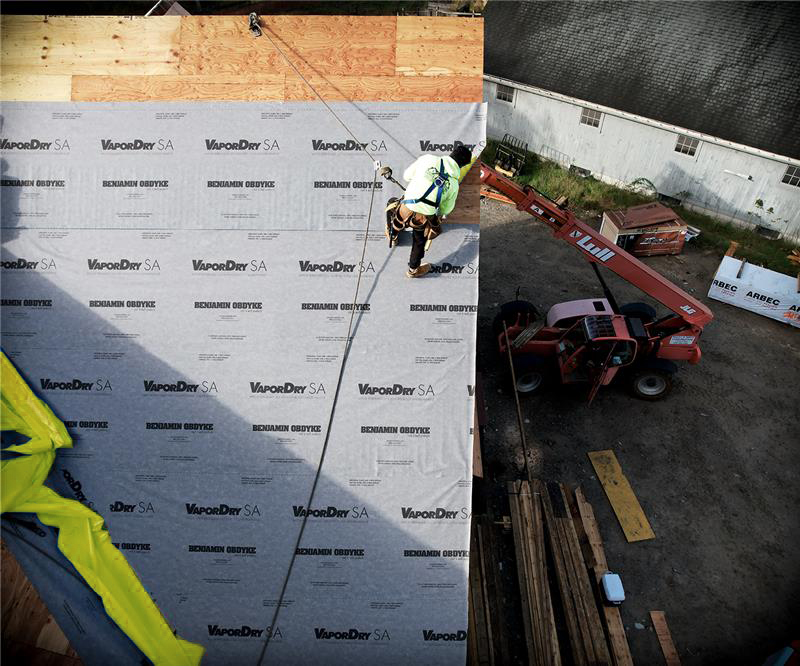
- VaporDry SA is a vapor-permeable roof underlayment used when outward drying through the roof deck is part of the design strategy. This becomes particularly valuable when inward drying is limited by the insulation system. A vapor-permeable exterior layer provides another potential direction for moisture to leave the assembly.
- AeroNet ventilation mat complements that strategy by creating a ventilated space above the roof’s water-control layer. In an appropriately designed ventilated or “cold roof” assembly, the airspace helps separate the roofing from the roof deck and provides a pathway for ventilation and drying.
- Cedar Breather provides a drainage and ventilation space beneath appropriate roofing materials, helping manage incidental moisture and allowing the underside of the roofing to dry.
Insulation Installation Plays a Role in Moisture Control
Like any area of the building envelope, proper installation is just as important as material selection to ensure the roof performs as designed.
Ensuring continuity and preventing air leakage are key. Uncontrolled airflow brings moisture with it, which can accumulate on the roof’s sheathing.
Avoid gaps and compression in the insulation, be sure to seal penetrations (plumbing, electrical, etc.) and transitions (partition wall intersections, roof-to-wall transitions), and properly connect the roof and wall air-control layers. For ventilated/unconditioned attics, be sure to maintain required ventilation pathways.
Energy Efficiency and Moisture Control Must Go Hand in Hand
When thinking about moisture and the building envelope, our first thought is typically about preventing exterior moisture from entering the assembly. But drying out is just as critical, particularly as homes have gotten, and continue to get, tighter for greater energy efficiency.
Roof assemblies made up of several high-performing products may combine to create a vapor trap. For example, interior insulation that restricts inward drying and a low-perm roofing underlayment can trap moisture in wood sheathing.
Vapor-closed assemblies can work, but they require climate-specific analysis, excellent air control, and confidence that the assembly will remain dry. A vapor-open approach can be more resilient by preventing bulk water, controlling interior air and vapor, allowing diffusion, providing drainage, and promoting ventilation and drying.
As insulation strategies get more aggressive and inward drying becomes more limited, providing outward drying with product combinations such as VaporDry SA with AeroNet becomes increasingly valuable.
Want to learn more about incorporating Benjamin Obdyke products into your specifications? Visit our Support page